

A good finish starts long before the scissors come out.
How a coat is dried affects how evenly it stands, how clearly the groomer can see the shape, and how smoothly a comb, clipper guard, or pair of shears moves through the hair. A coat may feel dry on the surface while staying damp or curled closer to the skin. Those hidden areas often show up later as uneven clipper work, soft spots in the outline, or hair that drops after the groom is finished.
Drying is also one of the busiest parts of an appointment. The groomer is managing airflow, a brush, the pet’s position, sensitive areas, and the clock at the same time. More groomers are now looking beyond raw dryer power and asking a more practical question: does the dryer fit the way they actually work at the table?
Why More Groomers Want to Work With Both Hands
During brush drying, one hand may be using a slicker brush while the other separates the coat, supports a leg, keeps a puppy from spinning, or helps a senior dog stay balanced. When one hand is tied up holding a dryer, every other part of the job has to be managed with the remaining hand.
That is where a Pet neck dryer starts to make sense. It keeps air moving toward the coat while leaving both hands available for brushing, handling, and checking the roots.
On a puppy, that may mean keeping one hand on the body while introducing airflow. On a senior dog, it may mean supporting the chest or rear while working through damp hair. On a Poodle or Bichon, it means following the brush through the coat instead of repeatedly setting the dryer down.
A Dog Neck Dryer is particularly useful during detailed brush drying, when the groomer needs the air to follow the brush. The groomer can work one section at a time, feel for damp areas, straighten curled hair, and adjust the dog’s position without stopping the airflow.
This is the practical value of grooming with both hands. Brushing, handling, coat checking, and drying can happen together. For groomers who regularly work on Doodles, Poodles, Bichons, Asian fusion trims, or full scissor finishes, that can improve dog grooming efficiency without rushing the pet or cutting the prep process short.

Why Traditional Drying Methods Can Slow the Workflow
The need for hands-free drying is not new. Long before today’s neck dryers appeared, some groomers rested a barrel-style handheld dryer against the neck or held it between the shoulder and the side of the head.
It worked, but the groomer had to tilt the neck, raise one shoulder, and keep the dryer pointed toward the pet while brushing. Changing sides often meant shifting the dryer, turning the head, or changing the entire body position.
Later, holders and neck attachments were introduced to keep those barrel dryers in place. They helped prevent the dryer from slipping, but the attachment still had to support a full-size handheld unit. The setup could be bulky and heavy, and groomers often still needed to lean or hold the head at an awkward angle to maintain the airflow direction.
Heat was another issue. A conventional handheld dryer can become warm during a long fluff dry. When the motor and housing sit close to the neck or shoulder, that heat becomes much more noticeable. Add the weight of the unit and the need to maintain an uneven posture, and a quick hands-free workaround can become tiring during a full day of grooming.
The modern pet neck dryer shape grew from that real salon need. Instead of hanging a traditional dryer from an accessory, newer designs combine a lighter dryer body, wearable support, adjustable airflow positioning, and controls intended for brush drying and finishing.
That does not make other dryers outdated. A force dryer—also commonly called an HV or pet high velocity dryer—is still the right tool for bulk water removal. It can push water out of a thick coat, open packed undercoat, and move a soaking-wet dog through the first major drying stage much faster than a finishing dryer.
The limitation appears later. A pet force dryer hose normally takes one hand to control. Once most of the water is gone and the job shifts to brushing, straightening, checking roots, and setting the coat, the groomer may no longer need the same pressure. What they need is steady, controllable air that can stay with the brush.
A stand dryer frees both hands, but the airflow remains tied to the stand. Moving from one side of the pet to the other may mean repositioning the arm, turning the dog, or changing where the groomer is standing.
Pet handheld dryers fill another category, but most compact models on the market are designed primarily for home grooming. They are useful for drying one family pet or handling occasional touch-ups, but they are not always built for a full salon schedule, repeated coat prep, heavy hair exposure, or extended fluff drying.
A neck dryer for dog grooming is more specialized. It is designed around how a professional groomer moves at the table, rather than how a pet owner dries one dog after a bath.

What Does a Neck Dryer Actually Change?
The biggest change is simple: the groomer can keep the air moving without holding the dryer.
Instead of drying a section, putting the dryer down, brushing, picking it back up, and trying to find the same angle again, the groomer can brush while the air is already working through the coat. One hand can steady the pet or separate the hair. The other can work a slicker brush or comb through the section.
For brush drying, this makes it easier to work methodically and keep the air moving in the same direction as the brush. During fluff drying, it helps lift and separate hair from the root instead of only drying the surface.
A hands free pet dryer also makes it easier to respond when a dog sits down, spins, pulls a foot away, or leans toward the edge of the table. Both hands are already available, so the groomer does not have to find a safe place for the dryer before correcting the pet’s position.
A purpose-built wearable dryer may also help reduce grooming fatigue by removing some repeated lifting, holding, and repositioning from the job. The larger benefit, however, is a smoother pet grooming workflow with fewer stops between drying, brushing, handling, and coat checking.
This is what groomers are evaluating in professional communities. In the Facebook Groomers Uplifting Groomers 2.0 group, groomers have asked whether newer neck dryers are genuinely useful or simply another heavily advertised tool. Working groomers want to know whether a new piece of equipment improves prep, removes unnecessary movements, and earns a place in the daily rotation.
Similar questions appear in the r/doggrooming discussion “Neck Dryers: Yay or Nay?”. Groomers describe using neck dryers for daily brush drying, fluffy haircuts, senior dogs, puppies, and dogs that do not tolerate HV airflow well.
Some H1 users in the discussion mention its neck support and wider range of movement as practical advantages. Others say they use it during fluff drying or when a dog cannot comfortably handle a force dryer.
Not every comment is positive. Some groomers note that higher heat settings may become uncomfortable near the neck or that certain dogs dislike the pitch at higher speeds. These are individual experiences rather than universal results, but they show what professionals actually care about: mobility, comfort, noise, control, and where the dryer fits into the groom.
Share From Professional Groomer
Professional groomer Johnathan Pires has also shared his firsthand experience with H1. He placed first in the Professional category and won Best in Show at Groom Brasil 2023, and later took second place at Hyponic IGC 2023. In his everyday client work, he especially values the way H1 combines powerful airflow with negative-ion technology in a single tool.
He said, “The H1 delivers exceptionally powerful airflow while simultaneously generating negative ions—a game-changing combination for pet coat health. This innovative feature has redefined grooming standards, allowing my clients to leave with visibly superior results that set them apart.”
For Johnathan, this combination helps open, separate, and organize the coat during brush drying and fluff drying. It also leaves the finished coat looking smoother, fuller, and more polished, creating a better foundation for scissoring and the final finish.
Where Neck Dryers Work Best
When the Coat Is About 80% to 90% Dry
A neck dryer is usually not the first dryer used on a soaking-wet pet. Towels and a force dryer are more effective for removing the initial load of water.
The neck dryer becomes especially useful when the coat is no longer dripping and most bulk moisture is gone, but the roots, legs, chest, rear, or thicker sections still need attention. Groomers often describe this point as roughly 80% to 90% dry. It is a practical estimate, not a measured rule for every coat.
At this stage, the job changes. The groomer is no longer simply pushing water out. They are brushing, separating, straightening, lifting, and checking. One hand may keep the pet in position or provide reassurance while the other works through the remaining damp areas.
| Drying stage | Approximate coat condition | Common tool | Main job |
|---|---|---|---|
| Towel work | 0%–30% dry | Towels | Remove dripping and surface water |
| Bulk drying | 30%–80% dry | Force dryer | Push out water and open the coat |
| Brush drying and prep | 80%–90% dry | Neck dryer or stand dryer | Brush, straighten, separate, and lift |
| Final finishing | 90%–100% dry | Neck dryer, comb, finishing tools | Find damp spots and reset the finish |
These percentages are only meant to show the sequence. A dense Doodle coat, a light Maltese coat, and a short-coated dog will move through the stages differently.
Puppies, Kittens, Senior Pets, and Pets That Dislike HV Air
Puppies and kittens may not be ready for the full pressure and sound of a force dryer, especially near the head. They are still learning that the table, brush, airflow, and handling are normal parts of grooming.
A lower neck-dryer setting gives the groomer another way to introduce airflow while keeping one hand on the pet. The groomer can start slowly, maintain physical contact, and increase the setting only if the animal remains comfortable.
Senior pets may also need more support. A senior dog may tire quickly, sit repeatedly, or need help balancing while a leg or rear section is dried. A cat may need calm, steady handling throughout the process.
Some pets are not afraid of every dryer. They simply dislike the pressure, hose movement, or sound of an HV dryer. A neck dryer for groomers gives the professional another option after most of the water has already been removed.

Faces, Heads, Rear Ends, and Detail Areas
Low airflow can be useful around the cheeks, topknot, chin, chest, tail base, rear coat, and other areas that require more control.
Drying the face does not mean aiming air directly into the eyes, nostrils, or ear canals. It means using a lower setting, working from a safer distance, and angling the air across the hair around the cheeks, head, and chin.
The rear is another area where both hands are useful. One hand may need to lift the tail or keep the pet standing while the other brushes through the coat. On a cat or small dog, trying to do this while holding a traditional dryer can feel like one task too many.
Higher airflow can make body work faster, but it is not the right choice for every pet. Some animals are comfortable at low or medium settings but become uneasy as air pressure and sound increase. The setting should follow the pet, not the clock.
Big, Fluffy Haircuts
A full Poodle topknot, round Bichon head, fluffy Doodle finish, or clean set of column legs starts during drying—not during the last few snips.
The coat needs to be dry at the root, separated, and standing evenly before the groomer can see the true shape. Damp or partially curled sections can make one area look shorter or heavier than it really is. They may also drop after the haircut, changing the finished outline.
That is why drying before scissoring matters. A thorough fluff dry gives the groomer a more consistent surface for clipper guards and shears. It makes low spots easier to see and helps the haircut hold its intended shape.
A neck dryer allows the groomer to keep air moving while working a slicker brush through the coat. The groomer can lift from the root, brush in controlled sections, and check the work with a comb without repeatedly changing tools.
Prep Work and Final Finishing
Many groomers use a neck dryer twice during the same appointment.
The first use is during prep. After force drying, the groomer can brush dry, straighten, separate the coat, and build lift before the main haircut. This coat preparation affects how evenly the clipper and shears move through the hair.
The second use comes after the main haircut. Handling, combing, and the pet sitting or lying down can flatten sections of the coat. A quick refluff brings those areas back up and reveals uneven lines that were hidden before.
| Grooming stage | Typical neck dryer work | Goal |
|---|---|---|
| Prep work | Brush drying, root lift, coat separation, straightening | Build an even base before cutting |
| Main haircut | Dryer is usually set aside | Establish the main shape |
| Final finishing | Refluffing, damp-spot checks, volume reset | Reveal uneven areas and refine the outline |
That makes a professional neck dryer useful for both prep and dog grooming finishing, rather than only for the last few damp spots.
Veterinary Clinics and Pet Care Settings
A wearable dryer can also make sense in veterinary clinics, pet hospitals, rehabilitation settings, and other professional care environments.
After cleaning or a localized rinse, a veterinary assistant may need to dry an area while keeping the animal supported. Lower airflow can be helpful for cats, small dogs, senior pets, and animals that do not tolerate pet blow dryer pressure.
This does not make a neck dryer a medical device. Wounds, surgical sites, active skin conditions, and medically fragile pets should only be dried according to veterinary direction. The practical benefit is that the staff member can keep both hands available for handling and observation.
Where a Neck Dryer Fits in the Full Drying Workflow
A neck dryer is not a replacement for a force dryer. It does a different job.
A force dryer handles bulk water. A stand dryer provides fixed hands-free airflow. A neck dryer gives the groomer mobile airflow without occupying either hand. A pet handheld dryer provides targeted air but still occupies one hand. A cage dryer provides passive drying under supervision but does not allow the coat to be brushed and shaped at the same time.
Neck Dryer vs. Stand Dryer vs. Force Dryer
| Dryer type | Hands needed to hold it | Best stage | Best use | Typical user |
|---|---|---|---|---|
| Neck dryer | 0 | Prep and finishing | Mobile brush drying, fluffing, detail work | Professional groomers and care teams |
| Stand dryer | 0 | Prep | Fixed-position fluff drying and straightening | Grooming salons |
| Force dryer / HV dryer | Usually 1 | Bulk drying | Removing water and loose undercoat | Salons and higher-demand home users |
| Pet handheld dryer | 1 | Light drying and touch-ups | Small areas and occasional home use | Mainly pet owners |
| Cage dryer | 0 | Passive drying | Supervised, low-contact drying | Salons, clinics, boarding facilities |
In a neck dryer vs. force dryer comparison, the question is not which one is better. The question is which stage of the groom you are in. A force dryer is the better choice for a soaking-wet double coat. A neck dryer is the better fit once the groomer needs to brush, straighten, and control the coat.
In a neck dryer vs. stand dryer comparison, both free the groomer’s hands. The difference is mobility. A stand dryer stays with the stand. A neck dryer stays with the groomer.
Most pet handheld dryers are aimed at home users who need occasional drying or touch-ups. A professional salon tool needs to support repeated coat prep, longer sessions, and heavier exposure to pet hair.
What to Look for in a Professional Neck Dryer
A professional neck dryer should feel like a tool made for a working groomer—not a household dryer placed inside a neck attachment.
Start with weight and balance. A lighter unit is easier to wear, but balance matters just as much. The dryer should remain reasonably stable when the groomer bends, turns, and moves around the table. A unit that constantly swings or pulls to one side creates a different problem instead of solving the old one.
Next, look at airflow, temperature control, and low-setting noise. Low should be meaningfully lower for small pets, senior pets, faces, and animals that do not like HV air. Higher settings should provide enough airflow for body brush drying and a full fluff dry.
The range of movement also matters. The outlet should adjust far enough to cover the body, chest, legs, head, and rear without forcing the groomer to twist into an awkward position. The airflow should follow the brush, not make the groomer chase it.
A salon tool also needs enough performance for repeated use. Most compact pet handheld dryers are made for occasional home grooming. A professional pet dryer should support real coat prep, not only light surface drying.
Finally, consider maintenance and safety. Filters and air inlets should be easy to inspect and clean. Temperature controls should be clear, and a removable handheld mode can be useful for the belly, armpits, feet, and other areas that are difficult to reach in neck mode.
Why Harmony I Fits This Kind of Work
This is where the Jirpet Harmony I Pet Neck Dryer enters the discussion.
Jirpet did not invent the neck dryer, and Harmony I was not the first product in the category. What it does is take a workflow groomers were already trying to create—first by balancing a barrel dryer on the shoulder and later by using bulky holders—and turn it into a purpose built professional tool.
A Lighter, Purpose Built Neck Design
Harmony I uses a compact dryer body and dedicated neck support instead of asking the groomer to wear a full-size conventional handheld dryer.
The goal is straightforward: keep the unit light enough for prep and finish work, stable enough to move around the table, and flexible enough that the groomer does not have to keep the neck tilted to hold the airflow in place.
This matters because the unit may be used for more than a quick touch-up. A groomer may wear it through the prep on a Poodle or Doodle, set it aside during the haircut, and put it back on for the final refluff.

Three Air Speeds and Three Temperature Settings
Harmony I offers three airflow levels and three temperature settings, giving the groomer nine possible combinations.
The lowest setting is intended for quieter, more controlled work. It is a practical starting point for kittens, puppies, small dogs, senior pets, faces, and animals that dislike force-dryer pressure.
Higher settings move through body work and fluff drying faster. That extra airflow can be valuable on a busy salon day, but it still needs to match the pet. Some cats and dogs are comfortable on low and become uneasy when the sound or pressure increases.
| Harmony I feature | Number | Practical use |
|---|---|---|
| Airflow settings | 3 | Adjust for pet size, coat, area, and tolerance |
| Temperature settings | 3 | Match heat to distance and drying stage |
| Possible combinations | 9 | 3 airflow levels × 3 temperatures |
| Operating modes | 2 | Neck mode and handheld mode |
| Main workflow uses | 2 | Prep work and final finishing |
| Brushless motor speed | 110,000 RPM | Supports professional brush drying and fluffing |
These are controls, not automatic programs. There is no single setting that works for every puppy, cat, or Poodle. The groomer still needs to watch the coat and the animal.
110,000 RPM Brushless Motor for Fluff Drying
Harmony I uses a 110,000 RPM brushless motor. The value of that specification is not the number by itself. It is the ability to produce professional working airflow from a compact unit that does not need to remain in the groomer’s hand.
For a Poodle, Bichon, or Doodle, the groomer can keep air moving through the section while working the slicker from the root. This supports more thorough fluffing, better coat separation, and a more even base for clipper guards and shears.
H1 does not create the haircut on its own. It gives the groomer a better-prepared coat to cut.
A Wider Range of Rotation
Harmony I also offers a wider rotation range than many earlier pet neck dryer setups. The groomer can reposition the airflow for the body, chest, legs, head, or rear without repeatedly moving a stand or turning the pet.
This feature comes up in the r/doggrooming neck dryer discussion. Groomers who have used H1 mention the neck support and freer range of movement as advantages.
Others describe using it for fluff drying and for dogs that cannot comfortably handle HV airflow. These are individual groomer experiences, but they match the work the product was designed to do.
Built for Prep and Finish Work
Harmony I is especially useful once the pet is around 80% to 90% dry.
During prep, the groomer can use it for brush drying, straightening, root lift, and coat separation. The dryer can then be set aside while the main haircut is completed.
After clipping or scissoring, H1 can come back out for finish work. A quick refluff lifts areas that were flattened by hands, combing, or the pet sitting down. It also makes damp spots and uneven lines easier to see before the final check.
This two-stage use is one reason H1 can remain relevant throughout the appointment rather than becoming a tool that only comes out for one small area.
Neck Mode and Handheld Mode
Not every part of a pet is easy to reach in neck mode. The belly, armpits, feet, and tight detail areas may need a more direct angle.
Harmony I’s dryer body can be removed and used as a handheld unit for those areas. The groomer can use neck mode for most prep and fluff work, then switch to handheld mode when more precise airflow placement is needed.
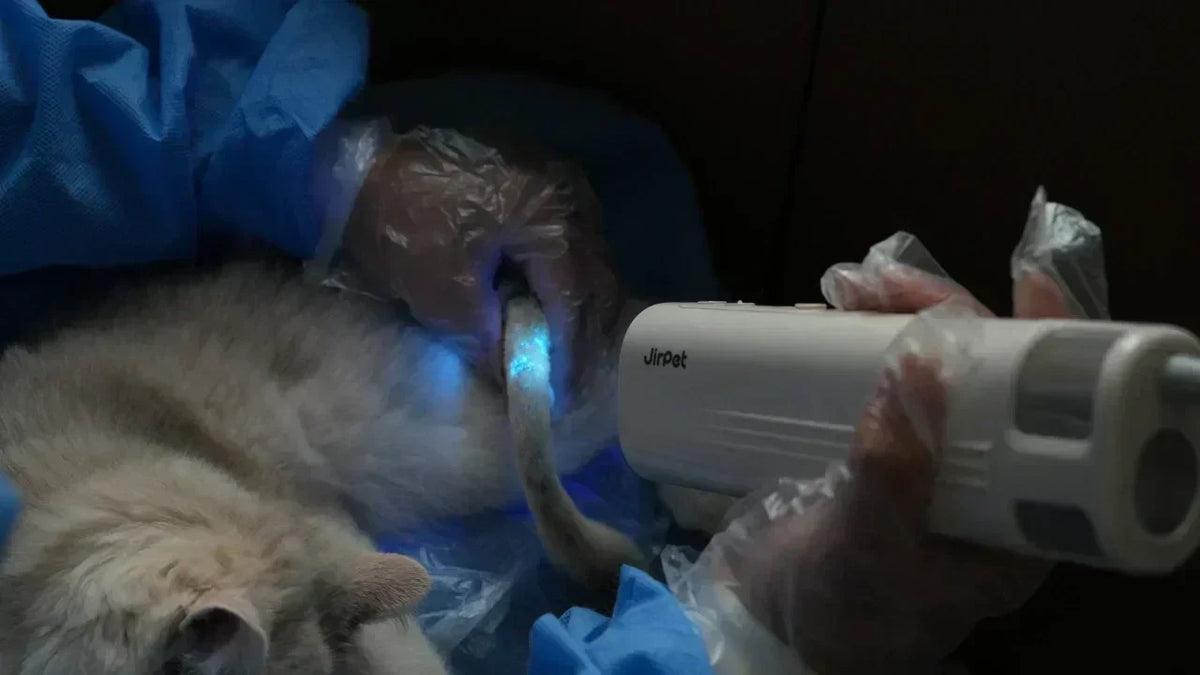
UV Inspection Light for a Quick Skin Precheck
Harmony I includes a UV inspection light that can be used to take a closer look at the skin and coat before grooming.
Under the right conditions, some hairs affected by certain ringworm infections may show a characteristic fluorescence. That may help a groomer notice a suspicious area before using the same tools, table, or workspace on other pets.
The UV light does not diagnose ringworm, rule out fungal infection, or prevent skin disease by itself. Its value is early awareness. If something looks suspicious, the groomer can pause the service, avoid sharing tools, clean the workLe area, and recommend that the owner speak with a veterinarian.

Useful Beyond the Grooming Salon
The same features can be useful in pet hospitals, veterinary clinics, and professional care settings.
A veterinary assistant may need to dry a cat or small dog after cleaning while keeping one hand on the animal. A senior pet may need support, or a localized area may need lower airflow rather than a pet force dryer hose.
Harmony I is not a medical device and should not be used over wounds or surgical areas without veterinary direction. The practical value is that the user can keep both hands available while controlling the airflow.
2025 Best New Product at Groom Expo
Harmony I received the 2025 Best New Product award at Groom Expo.
The 2025 Barkleigh Honors winners published by Groomer to Groomer list the winning product as the Harmony I Neck Dryer by Jirpet. The award was selected through voting within the U.S. professional grooming community.
The recognition does not mean H1 replaces every dryer or fits every pet. It means the product and the workflow behind it earned attention from groomers who understand what professional drying requires.
Safety Tips for Using a Neck Dryer
Use a neck dryer after towel drying and bulk water removal. A soaking-wet, heavy coat should normally go through the pet force dryer stage first. The neck dryer is better suited to brush drying, coat prep, fluffing, and finishing.
Start low, especially with puppies, kittens, senior pets, faces, and animals that dislike dryer noise. Increase airflow or temperature only when the pet remains comfortable and the coat calls for it.
Never aim air directly into the eyes, nostrils, or ear canals. Around the face, increase the distance, lower the setting, and angle the airflow across the hair.
Check the temperature with your hand throughout the groom. Do not leave warm air focused on one area for too long. Temperature controls and internal protection are useful, but they do not replace the groomer’s attention.
Watch the pet. Turning away, freezing, panting, scrambling, repeatedly sitting down, or trying to leave may mean the airflow, sound, heat, or overall session is becoming too much.
Keep long hair secured and away from the air intake. Check and clean filters and hair-catching areas regularly. Hands-free does not mean unattended; the groomer should stay with the pet and continue monitoring airflow, temperature, and behavior.
Use the UV light only as a visual precheck. Suspicious skin or coat findings should be referred to a veterinarian rather than diagnosed in the salon.
More Than a Hands-Free Dryer
A neck dryer does not replace a force dryer, stand dryer, or every handheld tool in the salon. It fills the space between bulk drying and the finished haircut.
The force dryer gets the water out. The neck dryer helps the groomer brush, straighten, lift, check, and finish the coat with both hands available.
That makes it especially useful when the coat is nearly dry, when a puppy or senior pet needs extra handling, when a pet does not tolerate HV pressure, or when the haircut depends on a thorough fluff dry. It also gives groomers a smoother way to move from prep work to final finishing without repeatedly stopping to reposition equipment.
Harmony I is built around those parts of the groom. It is not meant to be the only dryer in the room. It is meant to make the moments that require both hands easier to manage.