

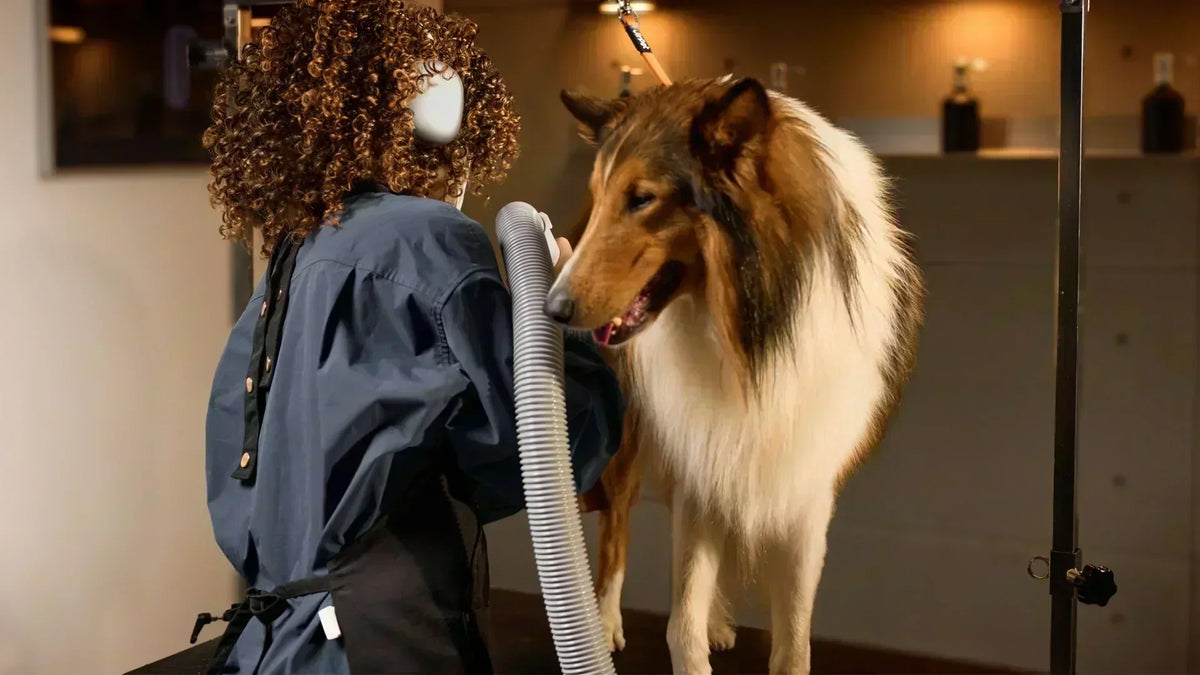
A Bath Cleans the Coat. Proper Drying Protects It.
A long-haired dog can look dry long before the coat is actually dry.
The back may already look fluffy and the surface hair may feel soft. But separate the coat behind the ears, under the front legs, across the chest, or around the base of the tail, and you may find moisture still sitting closer to the skin.
At Jirpet, drying is treated as a complete grooming workflow. As a professional Pet Grooming Equipment brand, Jirpet offers solutions from high-velocity Dog Dryer systems for heavy water removal to Pet Drying Cabinet options for controlled drying.

This is one of the easiest mistakes to make when drying a long-haired dog:
A dry-looking surface does not always mean the entire coat is fully dry.
The American Kennel Club notes that dogs with longer, thicker, double, or corded coats generally require more drying effort than short-coated dogs. Drying also gives owners and groomers an opportunity to inspect the skin more closely for irritation or other changes. [1]
For long-haired dogs, drying is about more than removing visible water. It affects moisture management, tangles, coat condition, skin checks, the dog's tolerance of the grooming process, and the final grooming result.
A professional grooming routine may begin at a Pet Grooming Table, move to a Pet Bathtub, and use several types of Pet Grooming Equipment before the groom is complete.
For example, a professional Twin Titan I high-speed Dog Dryer can support heavy water removal during the early drying stage. Jirpet currently lists Twin Titan I as a 5.0 HP dual-motor pet force dryer with stepless airflow control.
But better grooming is not about owning the greatest number of machines.
It is about understanding one question:
What does the coat need at this stage of the drying process?
Why Are Long-Haired Dogs Harder to Fully Dry?
The simple answer is that they have more hair.
The professional answer is more complicated.
Long coats vary in density, texture, layering, curl pattern, and undercoat volume. An Afghan Hound does not dry like a Samoyed. A Yorkshire Terrier has different coat challenges from a Newfoundland. A Poodle or Doodle also needs a different approach from a silky-coated Maltese.
Continental Kennel Club makes a useful observation: long hair tends to retain dirt, pollen, loose undercoat, and moisture closer to the skin. It also notes that compacted long hair can reduce airflow through the coat. [2]
This changes the way we should think about dog drying.

Dense double coats hide moisture below the surface
In dogs such as Samoyeds and Newfoundlands, the visible outer coat may begin to fluff while dense undercoat remains damp.
The groomer needs to separate the hair and inspect closer to the skin rather than judging dryness from the top of the coat.
Powerful airflow can be useful here because the goal is not simply to make the hair move. The airflow helps open dense coat layers so the groomer can see and work through them.

Curly and wool-like coats can hide tangles
Poodles, Bichons, and many Doodle-type coats present another challenge.
Small tangles can sit below the visible surface. If the coat is wet, aggressively rubbed with a towel, and then dried without sectioning and brushing, those tangles may become harder to manage.
Different areas may also dry at different speeds. The body may feel nearly finished while the legs, chest, or armpits remain damp.

Silky long coats are sensitive to friction
Maltese, Shih Tzus, Yorkshire Terriers, and other fine long-coated dogs may not have the same dense undercoat, but their hair can twist and tangle through unnecessary friction.
WOW Grooming recommends avoiding vigorous rubbing after washing. Instead, the body can be blotted, excess water can be gently removed from the ears, legs, and tail, and the coat can be dried in layers, section by section. [3]
That is one of the most practical Pet Grooming Tips for long-coated dogs:

Do not judge the coat only by how fluffy the surface looks. Separate the hair and check underneath.
What Can Happen When a Long-Haired Dog Is Not Fully Dried?
It is important not to overstate the medical connection.
Incomplete drying is not the single cause of every skin infection, hot spot, odor problem, or mat. Allergies, parasites, licking, scratching, and underlying skin conditions can all contribute to skin problems.
However, moisture remaining close to the skin may become part of a larger risk chain when combined with a thick coat, existing tangles, friction, or repeated scratching.
A simple way to understand the process is:
Hidden moisture → friction or tangling → increased licking or scratching → closer skin inspection becomes necessary
Moisture is often easiest to miss behind the ears, under the front legs, across the chest and belly, near the base of the tail, and within longer leg furnishings.
These are also areas where movement creates friction.
CKC identifies behind the ears, under the legs, along the chest, and around the tail as high-friction areas that deserve regular brushing attention. [2]
If a dog repeatedly licks or scratches one area after grooming, that behavior does not automatically diagnose a skin problem. It does mean the area deserves a closer look.
When persistent redness, pain, warmth, discharge, or a moist and expanding skin lesion appears, the problem should no longer be treated as a routine grooming issue.
Good grooming supports observation and preventive care.
Pet Grooming Equipment does not replace veterinary diagnosis or treatment.
Better Drying Actually Starts Before the Bath
Many drying problems begin before a Dog Dryer is ever turned on.
If a long-haired dog enters the bath with loose undercoat, hidden tangles, or compacted hair, the drying process is already more complicated.
CKC recommends daily light brushing and weekly more thorough brushing for most long-haired breeds. It also recommends paying close attention to high-friction areas and using a layered, skin-outward approach during deeper brushing sessions. [2]

Key timing numbers for long-haired coat maintenance
| Grooming Stage | Timing or Age Reference | Primary Goal | Why It Matters for Drying |
|---|---|---|---|
| Light coat brushing | Daily | Check high-friction areas and remove loose hair | Helps keep the coat separated before bathing |
| Thorough layered brushing | Once weekly | Work from the skin outward | Helps find hidden tangles below the surface |
| Puppy coat transition | About 4–8 months | Watch puppy coat and adult coat changes | Loose puppy hair may become trapped in the developing adult coat |
| Pre-bath detangling | Before each bath, as needed | Address existing tangles | Avoids entering the wet-coat stage with untreated knots |
| Professional grooming | Often every 6–8 weeks* | Deeper coat maintenance and mat management | Supports long-term coat care |
*The daily, weekly, 4–8 month, and 6–8 week references above come from CKC's general long-haired dog grooming guidance. They are not fixed medical schedules for every dog. Breed, coat condition, lifestyle, and professional judgment should be considered. [2]
The lesson is simple:
A professional drying result is partly determined by what happened before the bath.
Detangle the coat first. Check behind the ears, under the legs, across the chest, and around the tail. Separate the coat rather than brushing only the visible surface.

The grooming workspace should also be prepared before the dog is wet.
Towels, brushes, combs, and drying tools should be within reach. A groomer should not need to hold a wet dog while searching for equipment after leaving the Pet Bathtub.
A stable Atlas professional Pet Grooming Table can support coat sectioning, brushing, and inspection after the bath. The current Atlas design includes memory height presets and an integrated LED grooming arm.
In broader equipment terminology, this integrated support also connects naturally with the Pet Grooming Arm category.
More importantly, the workstation should help the groomer repeatedly:
separate the coat → inspect → dry → recheck → move to the next section
A Professional Drying Workflow for Long-Haired Dogs
For long-haired dogs, a multi-stage workflow is often more practical than expecting one dryer to complete every job.
Groomer to Groomer distinguishes stand dryers, force dryers, cage dryers, and handheld dryers as equipment with different purposes. It describes force dryers as an early drying tool commonly used to remove much of the moisture held in the coat and to help loosen packed undercoat. [4]
A professional long-haired dog drying workflow
| Stage | Main Action | Goal | Typical Tool | Progress Check |
|---|---|---|---|---|
| 1. Pre-bath preparation | Detangle and brush in layers | Find hidden tangles | Brush + metal comb | No obvious untreated problem areas |
| 2. Initial water removal | Blot instead of rubbing | Remove surface water | Absorbent towel | Coat is no longer continuously dripping |
| 3. Heavy water removal | Move water out of dense coat layers | Open the wet coat | High velocity Dog Dryer | Heavy visible water is reduced |
| 4. Layer-by-layer drying | Work section by section | Prevent surface-only drying | Dryer + brush | Current section is not clearly damp near the root |
| 5. Controlled finishing | Complete remaining drying | Improve overall consistency | Hands-free dryer / Pet Drying Cabinet | No obvious localized damp areas |
| 6. Final coat check | Hands + comb-through | Check coat, roots, and skin | Hands + metal comb | Key hidden areas have been inspected |
Blot the coat instead of creating more friction
A towel is a water-removal tool, not a scrubbing tool.
Press the towel into the coat and allow the material to absorb water. For long ear, leg, and tail hair, excess water can be gently pressed through the towel instead of twisting or aggressively rubbing the hair.
WOW Grooming specifically recommends blotting the body and removing excess water from the ears, legs, and tail before drying the coat in layers and sections. [3]
Remove heavy water before precision drying
This is where a high-velocity or force dryer is especially useful.
Groomer to Groomer explains that force dryers use powerful, concentrated airflow and are often used first to move moisture away from the skin and coat. They can also help loosen packed undercoat. [4]
That does not mean every dog needs maximum airflow.
A professional groomer adjusts speed, nozzle choice, direction, and distance according to the coat and the dog's tolerance.
After heavy water has been removed, the process should become more precise.
Separate the coat. Work through one area at a time. Check closer to the skin rather than sweeping airflow only over the top.

Use hands-free airflow when the coat work requires both hands
There are stages where the groomer benefits from having both hands available for brushing and sectioning.
The Harmony I professional hands-free neck dryer is designed around this grooming need and currently uses a 110,000 RPM high-speed brushless motor.
For users searching the term HV Dryer, the equipment category should still be explained accurately.
Harmony I is a hands-free neck pet dryer. It is not the same canister-style high-velocity force dryer category as Twin Titan I.
Its workflow role is hands-free drying support during selected coat-working and finishing stages.
Before the groom is considered complete, check at least five easy-to-miss areas:
-
Behind the ears
-
Under the front legs and armpits
-
Chest and lower belly coat
-
Base of the tail
-
Long leg and foot furnishings
A fluffy back does not prove that every layer of the coat is dry.

How Long Does It Take to Dry a Long-Haired Dog?
There is no professionally reliable universal answer such as 15 minutes, 45 minutes, or 1 hour.
Actual drying time can be influenced by:
-
Dog size
-
Coat length
-
Undercoat density
-
Pre-bath coat condition
-
Towel water removal
-
Room humidity and ventilation
-
Dryer type and airflow
-
The dog's tolerance of the drying method
For this reason:
Drying progress should be judged by coat condition, not by the clock alone.
A timer can help manage a grooming process. It cannot tell you whether the coat behind the ears is still damp.
This is also why a breed-by-breed drying-time table should be treated carefully unless the testing conditions are clearly documented.
Numbers that look scientific are not automatically useful data.
Where Does a Pet Drying Cabinet Fit in the Long-Haired Dog Drying Workflow?
The strongest professional position for a Pet Drying Cabinet is not: “This replaces every Dog Dryer.”
Its value becomes clearer when drying is treated as a workflow. After heavy water removal, selected dogs and coat types may benefit from a more controlled finishing stage. Rather than continuously moving a handheld nozzle across the dog's body, a cabinet uses a designed drying environment and airflow circulation.
This may also reduce continuous hands-on dryer operation during part of the workflow. For some dogs that are more sensitive to concentrated direct airflow, a groomer may decide to adjust drying techniques at different stages rather than use the same method from beginning to end. That does not mean a drying cabinet eliminates stress.
Every dog's behavior and tolerance should still be observed. A professional salon also needs to think about labor. Using a handheld force dryer means the groomer is actively managing the hose, nozzle, dog, and coat. A hands-free or cabinet stage changes how continuous manual drying time is allocated.
But the safety principle remains the same:
A Pet Drying Cabinet should support controlled drying, not unattended drying.
The pet should be monitored according to the equipment instructions, salon procedures, individual condition, and applicable local requirements.

How to Choose a Pet Drying Cabinet for Long-Haired Dogs
Do not begin with the question:
“Which Pet Drying Cabinet is the best?”
A more useful question is:
“What size pets do I usually groom, how much drying volume do I manage, and where will the cabinet fit into my current grooming workflow?”
A Maltese and a medium Doodle do not require the same cabinet space. A professional salon that regularly handles large dogs and multiple appointments has different equipment needs from a home groomer working primarily with small pets.
The current Jirpet Pet Drying Cabinet series includes F1, C7S, and CPlus. The three models are designed around different pet sizes, power requirements, cabinet capacities, and grooming workloads.
Jirpet Pet Drying Cabinet comparison
| Model | Recommended Pet Size | Capacity | Motors & Air Volume | Power Requirement | Best-Fitting Grooming Setting | Long-Haired Dog Workflow Role |
|---|---|---|---|---|---|---|
| F1 | Pets under 27.56 lb / 12.5 kg | 75 L / 19.8 gal | 1 brushless motor / 400 CFM | 15 Amp | Home grooming, home-based salons, small-pet care | Controlled drying for cats and small long-haired dogs |
| C7S | Pets under 44.09 lb / 20 kg, or 2 small pets | 170 L / 45 gal | 3 brushless motors / 1295 CFM | 20 Amp | Grooming salons, pet spas, multi-pet households | Medium-dog or two-small-pet drying workflow |
| CPlus | Pets under 132.28 lb / 60 kg | 405 L / 107 gal | 4 brushless motors / 2354 CFM | 30 Amp | High-volume salons, large dogs, multi-pet workflows | Large long-haired dogs and salon-scale controlled drying |
The figures above are current manufacturer-listed Jirpet specifications. F1 is listed at 75 L, 400 CFM, and 15 Amp; C7S at 170 L, 1295 CFM, and 20 Amp; and CPlus at 405 L, 2354 CFM, and 30 Amp.

Small long-haired dogs and cats: F1
For Maltese, Yorkshire Terriers, Shih Tzus, small Poodles, and cats, buying the largest cabinet is not automatically the most practical decision.
Cabinet size should match the pet and the grooming space.
The F1 Pet Drying Cabinet for small dogs and cats is a compact cabinet with a manufacturer-listed 75 L / 19.8 gal capacity, 400 CFM air volume, 15 Amp requirement, and recommendation for pets under 27.56 lb / 12.5 kg. Jirpet describes the airflow design as a 5D full-surround drying system.
For small long-haired pets, F1 can fit into a controlled drying or finishing stage without requiring the footprint and electrical installation of a larger professional cabinet.
Medium dogs or two small pets: C7S
When a grooming business regularly serves medium dogs, larger Poodles or Doodles, or needs to manage two small pets in one drying workflow, cabinet requirements change.
The C7S Professional Pet Dryer Cabinet has a manufacturer-listed 170 L / 45 gal capacity, 3 brushless motors, 1295 CFM air volume, and a 20 Amp requirement. Jirpet recommends the unit for dogs up to 44.09 lb / 20 kg or two small pets.
The advantage is not simply that C7S is “bigger than F1.”
Its role is broader workflow flexibility.
For salons serving a mixed client base, it can move the Pet Drying Cabinet category beyond small-pet drying and into medium-dog and multi-pet grooming routines.
Large dogs and higher-volume salons: CPlus
Large long-haired dogs present a different workload.
A Great Pyrenees or Newfoundland does not simply weigh more. The groomer is managing greater body surface area and substantially more coat.
The CPlus dual-cabin Pet Drying Cabinet is built around larger and higher-throughput grooming needs.
Jirpet currently lists CPlus with a 405 L / 107 gal capacity, 4 brushless motors, 2354 CFM air volume, and a 30 Amp electrical requirement. The recommended pet size is under 132.28 lb / 60 kg.
Its dual-door design can be configured for one large dog or two small-to-medium pets.
For a professional salon, CPlus is best understood as a workflow and capacity decision.
It is not simply “a larger F1.”
It is designed for salons managing large dogs, multiple drying appointments, and greater daily grooming volume.
Do not choose by cabinet size alone
The real difference between F1, C7S, and CPlus is not simply:
Small / Medium / Large.
Consider six questions:
Pet size: What size dogs or cats make up most of your client base?
Coat volume: Are you mainly drying silky coats, curly coats, or dense undercoats?
Daily grooming volume: How many animals need to move through the drying workflow each day?
Available power: Can the grooming space support 15 Amp, 20 Amp, or 30 Amp equipment?
Existing Dog Dryer: Is heavy water removal already handled by a high-velocity or force dryer?
Salon layout: Can the pet move safely and efficiently from the Pet Bathtub to the dryer and then to the Pet Grooming Table?
For dense long-haired dogs, a professional workflow may look like this:
High velocity Dog Dryer for heavy water removal → layer-by-layer coat work → F1, C7S, or CPlus for controlled drying when appropriate → final root and hidden-area check
The better question is not:
“Which Jirpet cabinet wins?”
It is:
“Which Pet Drying Cabinet matches my pet size, daily workload, available power, and existing grooming workflow?”
Final Takeaway: Better Drying Starts Before the Bath
The hardest part of drying a long-haired dog is not simply that the hair is long.
The challenge comes from coat structure, loose undercoat, hidden tangles, moisture, friction, airflow, the dog's tolerance, and grooming technique.
A tangled coat that enters the bath is already more difficult to dry.
Aggressive towel rubbing can create more friction.
Powerful airflow used only across the surface can leave hidden areas unfinished.
A Pet Drying Cabinet used as a universal replacement for every other dryer may not address the heavy-water-removal needs of dense undercoat.
And a groomer who watches only the timer may miss damp hair behind the ears or under the legs.
For long-haired dogs:
Better drying starts before the bath and ends only after the coat has been checked from the skin outward.
Brush consistently.
Understand the coat type.
Detangle before bathing.
Blot instead of rubbing.
Remove heavy water when the coat requires it.
Dry in layers.
Adjust airflow to the dog.
Use the right Pet Grooming Equipment at the right stage.
Monitor the drying process.
And check the coat before calling the groom complete.
The most professional drying solution is rarely a single machine.
It is:
the right drying method, used at the right time, for the right coat.
References
[1] American Kennel Club. “How to Dry Your Dog Properly and Why It's Important.”
Referenced for long, thick, double, and corded coat drying considerations and skin inspection during drying.
[2] Continental Kennel Club. Isha Noor. “What Long-Haired Dog Breeds Need to Stay Well Groomed.” January 15, 2026.
Referenced for retained moisture and loose undercoat, compacted coat and airflow, daily light brushing, weekly thorough brushing, high-friction areas, the 4–8 month coat-transition period, and general 6–8 week professional grooming guidance.
[3] WOW Grooming. Heather McKay. “Long-Hair Dogs and How to Groom Them.” June 8, 2022.
Referenced for pre-bath detangling, blotting rather than rubbing, removing excess water from ears, legs, and tail, and layer-by-layer, section-by-section drying.
[4] Groomer to Groomer Magazine. Jonathan David. “Dryers and Their Multitude of Options.” May 1, 2020.
Referenced for force dryer, stand dryer, cage dryer, and handheld dryer categories and their different roles in professional grooming.
[5] Los Angeles County Animal Care and Control. “Protecting Animals in Grooming Facilities.”
Referenced for Los Angeles County grooming facility requirements concerning fully enclosed heated cage or box dryers without safety vents, staff monitoring, and 15-minute cage-dryer observation intervals.
[6] Jirpet. Current manufacturer product pages for Twin Titan I, Harmony I, Atlas, F1, C7S, and CPlus.
Referenced for current product categories and manufacturer-listed specifications used in this article.