

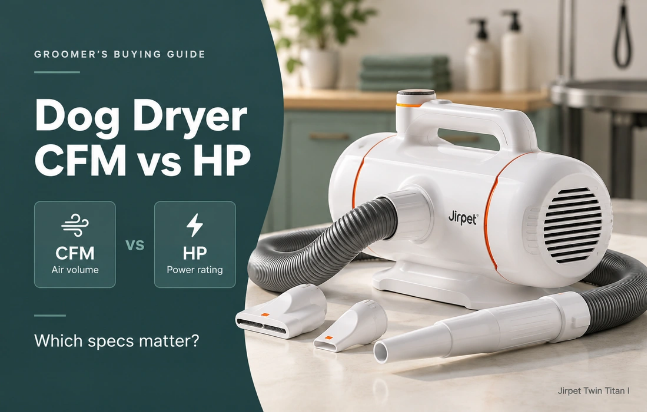
When choosing a high-velocity dog dryer, horsepower is often the first number you notice. A higher rating sounds like more drying power. But it does not tell you how much air reaches the coat, how easily you can control it, or how much preparation remains before trimming.
For a groomer, those differences matter more than the largest number on the product page.
Quick answer: CFM is more useful than HP for comparing air volume. HP describes a motor power rating. Neither is a complete buying rule: nozzle configuration, adjustable speed, heat options, and handling all affect how useful a dryer is during an appointment.
This guide focuses on choosing a force dryer for dogs—equipment that directs airflow through a hose and nozzle to remove water from the coat.
Before buying, establish three things:
What the published performance figures describe.
Whether the controls and attachments suit your regular appointments.
Which improvement would justify replacing your current equipment.
Already comparing Jirpet models? Jump to the Twin Titan I vs Twin Triton I comparison.
What Matters When Choosing a High-Velocity Dog Dryer?
Start with your working day, then use the specifications to narrow your choices.
A salon handling small dogs and dense-coated retrievers needs a useful adjustment range. A mobile groomer also needs equipment that fits the electrical supply and available space. Someone replacing an awkward hose may gain as much from better handling as from stronger output.
| Buying consideration | What to look for |
|---|---|
| Airflow | Performance information with a clear measurement setup |
| Speed control | Convenient adjustments across the range you expect to use |
| Nozzles and hose | Suitable coverage, comfortable handling, and adequate reach |
| Heating | Options that match your preferred drying routine |
| Noise | Information or demonstrations at realistic working settings |
| Electrical requirements | Specifications for the exact version being ordered |
| Maintenance | Accessible filters, replacement parts, and clear service terms |
CFM helps describe airflow, but it should not become a pass-or-fail test for the entire machine. A useful purchase brings together performance, control, and a practical fit for your workstation.
CFM, HP, Air Speed, and Watts: What Is the Difference?
These specifications describe different parts of a dryer’s operation.
| Specification | Meaning | What it helps you assess |
|---|---|---|
| CFM | Cubic feet of air moved per minute | Air volume under the stated measurement conditions |
| HP | Motor horsepower rating | The advertised motor rating, including peak or continuous wording |
| Air speed | How fast air moves at a stated location | Velocity, usually expressed in m/s or FPM |
| Input watts | Electrical power consumed under stated conditions | Power requirements and estimated electricity use |

CFM tells you how much air moves. Air speed tells you how fast it moves. A concentrated stream can feel fast without moving the greatest total volume.
Horsepower does not directly answer either question. The motor drives the fan, while the fan design and resistance through the air path affect the output. AMCA’s explanation of fan performance curves describes the relationship between airflow, pressure, and power.
Read the complete rating. “Peak HP” should not be presented as continuous output, and electrical input watts should not be treated as a direct measurement of drying performance.
For a high-velocity pet dryer, the useful comparison is the complete system: motor, fan, hose, nozzle, and controls.
Does More Horsepower Mean Faster Drying?
Not by itself. A higher horsepower rating does not establish how quickly the complete machine will prepare a coat for the next grooming step.
Suppose your current dryer struggles with a Golden Retriever. A higher-HP model may look promising, but the useful result is how much work remains after the first water removal.
Check whether you keep returning to damp sections. Notice whether stronger output is easy to direct or makes you reposition more often. Continue the comparison through the preparation you normally complete before brushing or trimming.
A dryer that quickly removes visible surface water can still leave considerable follow-up work. Likewise, maximum output offers limited benefit if you repeatedly turn it down because it is difficult to handle.
Dual-motor claims need the same perspective. Motor count describes the configuration; it does not independently prove shorter appointments, lower noise, or easier operation.
If drying speed is your reason for upgrading, compare the time and effort needed to reach the same endpoint. That is more informative than ranking machines by horsepower alone.
How Nozzles and Speed Control Affect Everyday Use
You work through the hose, nozzle, and controls. Small differences in these parts can become noticeable over several appointments.
Across a large dog’s body, broader coverage may be useful. On a smaller section, a focused stream and lower setting may be easier to manage. Changing the nozzle alters the airflow pattern and can change the resistance the dryer works against.
A narrower opening can concentrate the stream. A wider opening changes coverage. Neither is automatically the best choice for every stage.

During a demonstration, check:
Whether the nozzle directs air where you need it.
Whether you can make small speed adjustments without interrupting your handling.
Whether the hose follows your hand rather than pulling against your grip.
Whether you can reach both sides of the table comfortably.
Whether attachments are convenient to change and remain secure.
Try the controls with the hose in your normal working position. A dial that feels accessible beside an empty table may be less convenient during an appointment.
For coats requiring substantial preparation, also assess how the dryer works with brushing. The long-haired dog drying guide covers that wider workflow.

How to Compare Professional Dog Dryer Specifications
Before comparing published CFM, record the measurement setup alongside the number.
| Detail to confirm | Why it matters |
|---|---|
| Measurement location | A machine-outlet reading may not describe airflow through working attachments |
| Hose and nozzle | Their dimensions and configuration affect airflow resistance |
| Speed setting | Maximum output does not describe the whole adjustment range |
| Voltage and product version | Specifications may differ between versions |
| Measured or calculated result | An estimate should be distinguished from a product test |
If a listing publishes air speed but no CFM, treat those as separate facts. Do not calculate product airflow from a maximum velocity claim and an assumed nozzle diameter. The highest velocity is not necessarily the average across the outlet.
Published blow-force figures can add information, but they also require a defined test method. They are not interchangeable with airflow measurements.
For noise, check the operating setting, measurement distance, and method. A low-speed sound figure does not describe the noise at the output you expect to use.
When comparable measurements are unavailable, use the published features and a demonstration or detailed use video to assess the machine. The aim is to understand its capabilities without assigning more meaning to a specification than it supports.
Choosing a Dog Grooming Dryer for Your Daily Appointments
Start with the work that exposes the limits of your current setup.
Moving From a Small Poodle to a Golden Retriever
A mixed schedule calls for more than a strong maximum setting.
With the hose in hand, check whether you can make small adjustments without repeatedly changing position. Then assess whether higher output remains easy to direct on the larger coat.
For this workload, accessible controls and a useful adjustment range deserve close attention. You will use them throughout the day.
Working Through Dense Coats
During a heavy-coat appointment, the first burst of water leaving the surface is only the beginning.
Check how much moisture remains closer to the skin and how many sections need another pass. Include the additional drying and preparation needed before the next grooming step.
If a new machine saves blowing time but adds follow-up work, record both. The goal is less total effort to reach a consistent result. See the double-coated dog drying guide for a related workflow.
Fitting Equipment Into a Grooming Van
In a compact van, placement and electrical requirements can determine whether a dryer is practical.
Imagine moving around the table with the machine installed. Does the hose reach comfortably? Does it catch on storage? Can you change attachments without putting equipment in the walkway?
Check the exact version’s electrical requirements against the available supply and other equipment running at the same time. Then assess hose reach, storage, and access for cleaning.
Twin Titan I vs Twin Triton I: What Can You Compare?
Start with the feature that most clearly separates the two models: selectable heat.
The comparison below summarizes published information from the Twin Titan I and Twin Triton I product pages.

| Published specification or feature | Twin Titan I | Twin Triton I |
|---|---|---|
| Motor configuration | Dual motor | Dual motor |
| Advertised horsepower | 5.0 HP | 5.0 Peak HP |
| CFM information | Request airflow data for your setup | Request airflow data for your setup |
| Listed input power* | 2400W | 2000W |
| Speed control | Stepless | Stepless |
| Heating | Three heat settings | No built-in heating element |
| Included nozzle options | Four | Four |
Power figures come from the website’s model comparison. Confirm the specifications for the version being ordered.
Consider Twin Titan I if you want selectable heat. Consider Twin Triton I if you do not need a built-in heater. Unheated airflow can still warm during motor operation.
Need airflow information? Contact Jirpet with the model, hose length, and nozzle you plan to use. Ask which measured CFM data is available for that configuration.
View Twin Titan I specifications and price · View Twin Triton I specifications and price
Product overview video: Watch on YouTube
Look Beyond the Purchase Price
A professional dog dryer needs to suit your workload after the first week, not just look attractive on a specification sheet.
Before ordering, check filter access, cleaning instructions, replacement hoses and nozzles, warranty terms, and service arrangements. If you plan to mount the dryer, consider both hose movement and access for maintenance.

For electricity use, calculate from average input power and operating time:
Electricity used in kWh = average input watts ÷ 1,000 × hours of use
A machine averaging 2,000W for one hour uses 2kWh. Multiply that figure by your electricity rate to estimate energy cost. This is a calculation example, not a measured consumption result for either Jirpet model.
Time savings should be assessed against your schedule. Saving five minutes on six appointments would release 30 minutes. That could reduce overtime, create room between bookings, or support another appointment if the rest of the workflow allows.
If drying mainly creates a staffing bottleneck, consider the broader force dryer and drying cabin workflow before assuming a higher-powered machine will solve it.
Frequently Asked Questions
Q1: Is CFM More Useful Than HP for a Dog Dryer?
Yes, for comparing air volume. CFM describes airflow, while HP describes a motor power rating. Use comparable measurements alongside controls, handling, and coat results when choosing equipment.
Q2: Does Higher CFM Always Mean Faster Drying?
No. Under comparable conditions, higher CFM means more air volume. Drying time also depends on the nozzle, coat condition, preparation, and handling. Compare the work needed to reach the same grooming endpoint.
Q3: Can You Convert Dog Dryer HP to CFM?
No. There is no fixed conversion. Fan design, efficiency, and airflow resistance affect the result, so equal horsepower does not guarantee equal CFM.
Q4: How Much CFM Do I Need in a Dog Dryer?
Choose around the coats you groom most often and the airflow range you can comfortably use. For small, short-coated dogs, prioritize controllable lower settings. A mixed schedule calls for a broad adjustment range. For large dogs with dense double coats, give more attention to effective water removal and the drying work that remains close to the skin.
Compare usable output across the range rather than choosing by maximum CFM alone. Published airflow figures are most useful when the hose, nozzle, and measurement conditions are comparable.
Q5: What If a High-Velocity Dog Dryer Does Not Publish CFM?
Ask which measured airflow data is available for your intended configuration. If none is available, assess the published features and working performance through a demonstration or detailed video. Air speed and blow force provide different information; neither substitutes for CFM.
Q6: Does Higher HP Mean Higher Electricity Use?
Not necessarily. Estimate consumption from average electrical input power and operating time. The advertised horsepower rating does not tell you how many kilowatt-hours the dryer will consume.
Conclusion
When choosing a high-velocity dog dryer, use CFM to understand air volume and HP as supporting information. Then compare the controls, attachments, and operating requirements that affect your working day.
Explore Twin Titan I and Twin Triton I for current specifications, prices, and included accessories.
Choose around the problem you need to solve. If drying time is the issue, assess the complete appointment. If handling is the problem, focus on controls and hose movement. Confirm that the version you order fits your electrical supply and workstation.