

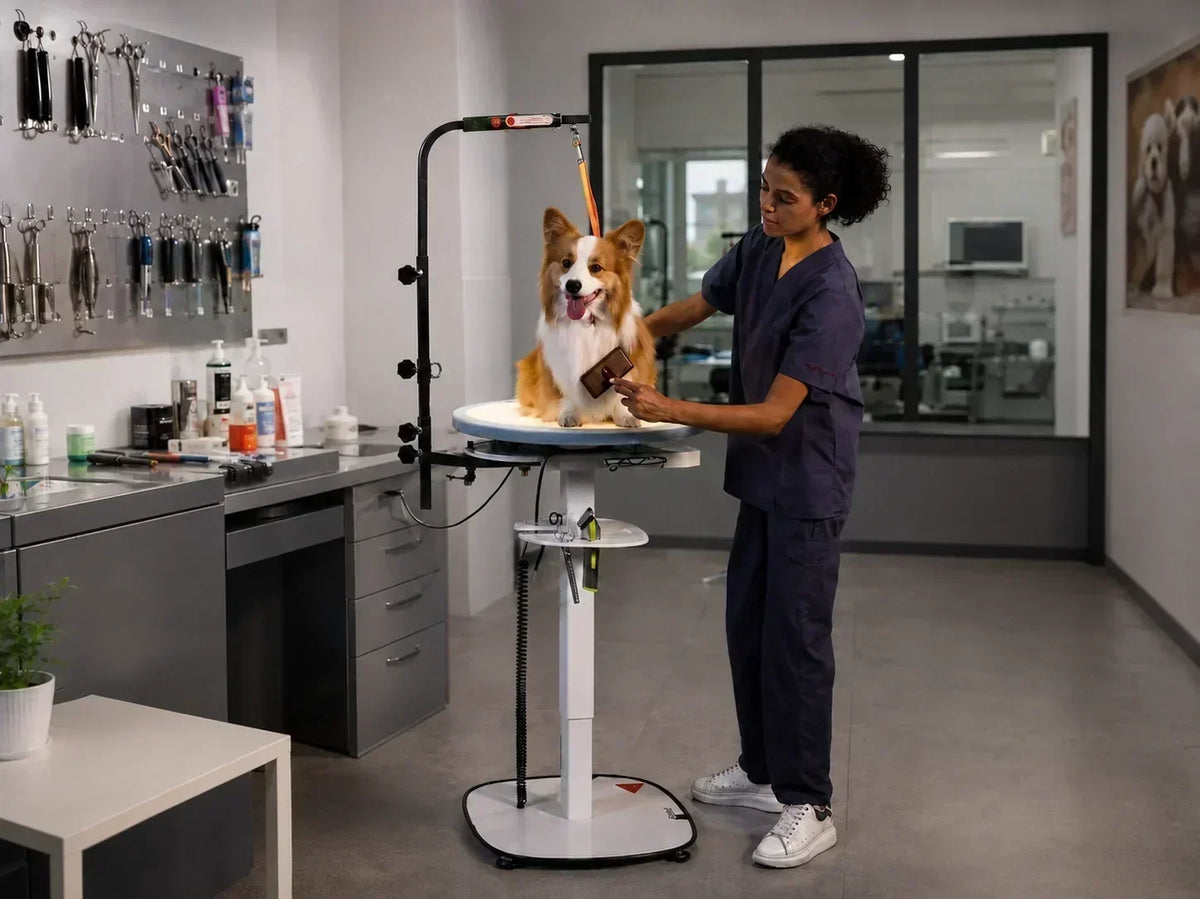
Professional dog grooming tools should be selected according to how a salon operates, because the right setup affects appointment flow, staff workload, and daily capacity. This guide is for professional dog groomers, salon owners, and anyone building a commercial grooming business—not for pet owners choosing occasional at-home tools. As a salon grows, its main operational constraint changes: a solo groomer may need to reduce time per dog, while a larger team may need to increase station capacity and throughput. For that reason, this guide organizes equipment decisions into three stages—solo, growing, and high-volume—so spending can follow actual business needs rather than aspirational volume.
What Equipment Does a Professional Dog Groomer Need?

Dog grooming instruments used in a professional salon differ from consumer-grade products in durability, motor performance, sanitation capability, and ergonomic design. A complete salon setup covers the main stages of a grooming appointment: positioning the dog, bathing, removing water, trimming and shaping the coat, managing different coat types, maintaining safety, and disinfecting the workspace. Each equipment category serves a distinct operational role, so the priority is to build a complete workflow rather than collect unrelated tools.
Professional Dog Grooming Equipment List What to Prioritize by Category
A professional dog grooming equipment list should identify each category’s role in the salon workflow before specific models or brands are compared. The table below distinguishes core workflow equipment from tools added for particular coat types or higher-capacity operations.
| Equipment Category | What It Does | Investment Timing |
|---|---|---|
| Height-adjustable grooming table | Positions the dog securely and supports an ergonomic working height | Core workflow equipment |
| Professional grooming tub | Provides a safe, washable station for bathing and rinsing | Core workflow equipment |
| High-velocity force dryer | Removes bulk water from the coat after bathing | Core workflow equipment |
| Hands-free or stand dryer | Maintains airflow while the groomer brushes and styles the coat | Add when brush drying limits workflow |
| Dryer cabinet | Provides controlled passive drying while the groomer handles another task | Add when drying overlaps with other appointments |
| Professional clippers and blades | Performs consistent trimming, shaping, and detail work | Core workflow equipment |
| Brushes and combs | Detangles, separates, smooths, and checks the coat | Core workflow equipment |
| Deshedding tools | Removes loose undercoat from heavy-shedding or double-coated breeds | Add according to coat types served |
| Safety restraints and grooming aids | Supports controlled handling and reduces movement-related risk | Core safety equipment |
| Cleaning and sanitation equipment | Supports routine cleaning and disinfection of tools and work areas | Core hygiene equipment |
This category-level checklist helps salon owners map equipment to workflow requirements without treating every tool as an immediate purchase. Detailed selection criteria for dryers, tables, coat-care tools, safety equipment, and sanitation procedures are covered in the sections that follow.
How Should You Choose Dog Grooming Equipment Based on Salon Size?
Dog grooming business equipment should be chosen according to the salon’s consistent daily appointment volume, because the main operational constraint changes as the business grows. A setup that works for a low-volume operation may become inefficient when the same team handles more appointments, even if the individual tools still function properly.
Use this three-step process:
1. Measure your normal daily volume. Count the average number of dogs completed on a typical operating day, rather than using an occasional peak or target figure.
2. Locate the current bottleneck. Determine whether appointments are being limited by time per dog, staff fatigue, or the salon’s overall capacity to keep work moving.
3. Invest against that bottleneck. Prioritize the change that removes the current constraint, then reassess the workflow after volume or staffing changes. Optional upgrades and duplicate equipment should follow a demonstrated operational need, not precede it.
Solo Groomer Must-Haves What Do You Actually Need at 1–5 Dogs Per Day?

A solo groomer handling 1–5 dogs per day should first equip the salon with six core categories of professional dog grooming tools: a height-adjustable grooming table, professional tub, force dryer, clipper set, coat-appropriate brush and comb kit, and safety restraints. These categories support the basic appointment workflow; higher-capacity equipment can wait until the salon develops a measurable operational bottleneck.
·Grooming table: Height adjustability keeps the dog at a workable level and reduces sustained back bending during each appointment.
·Professional tub: Fast drainage and a disinfectable, non-slip surface support safe bathing and a smooth transition between dogs.
·Force dryer: High-velocity airflow removes bulk water after bathing and supports efficient coat preparation without relying on towel drying alone.
·Clippers and blades: A commercial motor helps maintain consistent blade speed during repeated use, reducing overheating, coat pulling, and appointment delays.
·Brushes and combs: Coat-appropriate tools reach the surface coat, undercoat, or skin with fewer unnecessary passes.
·Safety restraints: A grooming arm, loop, non-slip mat, and basic first-aid supplies help control movement and manage minor incidents.
At 1–5 dogs per day, defer a dryer cabinet unless passive drying regularly interrupts another appointment or prevents the groomer from starting the next task. The first investment priority should be equipment that supports a complete, reliable workflow for the current daily volume.
Growing Salon Must-Haves What Changes at 5–10 Dogs Per Day?

A grooming salon handling 5–10 dogs per day often reaches a groomer-fatigue limit before it reaches a space limit, because repeated bathing, lifting, brushing, and finishing create cumulative physical strain across the workday. At this stage, equipment upgrades should focus on reducing repetitive effort, improving posture, and preventing workflow interruptions.
·Hands-free dryer: Add one at the brush-drying station when the salon handles 5 or more dogs per day, especially if long, curly, or dense coats are common. It lets the groomer use both hands for coat control while airflow continues.
·Adjustable grooming table: Upgrade when groomers frequently change working height between smaller and larger breeds. Faster, easier adjustment reduces repeated bending and repositioning.
·Duplicate high-use tools: Add a second clipper, blade set, or other frequently occupied tool when waiting for cooling or disinfection regularly interrupts appointments.
·Dryer cabinet: Consider this as the salon begins to manage overlapping drying tasks, but reserve the detailed threshold and return-on-investment analysis for the dedicated dryer-cabinet section.
At 5–10 dogs per day, evaluate upgrades by the physical effort and active labor they remove from the workflow. The priority is not to own more equipment, but to reduce the repetitive tasks that make the groomer the limiting factor.
High-Volume Salon Must-Haves What Does a 10 Plus Dogs Per Day Salon Actually Need?

A high-volume grooming salon processing 10 or more dogs per day needs commercial dog grooming equipment that can support continuous, multi-groomer operation, because a delay at one station can affect the entire appointment schedule. The priority at this stage is maintaining continuous throughput when equipment is occupied, being cleaned, or temporarily unavailable.
·Multiple force dryers: Provide enough active units for simultaneous bathing and drying so groomers do not wait for a shared dryer.
·Hands-free dryer at each active station: Keep brush drying and styling moving without requiring another groomer to hold the airflow.
·Dryer cabinet capacity: Integrate cabinet capacity into the overall workflow so passive drying does not block bathing, trimming, or finishing stations.
·Commercial grooming tables: Select tables with fast height adjustment and weight ratings that cover the salon’s regular breed mix.
·Backup clippers and dryers: Keep replacement units available so a motor fault, overheating issue, or maintenance stop does not cancel appointments.
·Dedicated sanitation and electrical systems: Separate clean and used tools, maintain rapid disinfection turnover, and confirm that concurrent dryer loads remain within the circuit’s safe rating.
At this volume, evaluate each station by how consistently it can keep work moving through bathing, drying, trimming, and cleanup. Add capacity where a measured queue, maintenance delay, or shared-tool dependency interrupts appointments—not simply because the salon has more staff or floor space.
What Kind of Grooming Table Does a Professional Salon Need?
A professional grooming table is the salon’s primary ergonomic tool because its height, weight capacity, stability, and surface affect how safely and consistently a groomer works through each appointment. Choose a table by evaluating its height range first, weight rating second, and lifting system third; motor type should follow the salon’s handling needs rather than lead the decision.
A suitable professional grooming table should provide:
·An appropriate height range that allows the groomer to work without sustained back flexion.
·A reliable weight rating that safely covers the salon’s largest regular breed with an operating margin.
·A stable, non-slip surface that supports controlled handling during bathing, trimming, and finishing.
·An adjustable grooming arm and restraint points suited to different dog sizes and workflows.
·Easy-clean, non-porous materials that tolerate routine disinfection between appointments.
A lifting system matched to how often the salon changes working height during the day.
Electric vs Hydraulic Grooming Table Which Is Right for a Professional Salon?

Electric and hydraulic grooming tables both support professional use, but the appropriate choice depends on daily dog volume, breed-size variation, and how often the groomer must change working height. Electric tables use powered adjustment for fast repositioning, while hydraulic tables use a manual foot pump and usually require the groomer to pause the workflow.
| Decision factor | Electric grooming table | Hydraulic grooming table |
|---|---|---|
| Height adjustment | Powered adjustment in seconds | Manual foot-pump adjustment |
| Best operating profile | At least 8 dogs per day, mixed breed sizes, and frequent height changes | No more than 5 dogs per day, consistent breed profile, and limited height changes |
| Workflow effect | Height can change without significantly interrupting handling | Groomer generally pauses to pump and reposition |
| Physical effort | Reduces repeated pumping, bending, and repositioning | Requires more manual effort throughout the day |
| Capital constraint | Higher initial purchase cost | Lower initial purchase cost |
| Best reason to choose | Frequent mid-session and between-dog adjustments | Stable dog mix with limited daily adjustments |
Decision rule: Choose an electric table when the salon handles at least 8 dogs per day, serves substantially different dog sizes, and changes table height frequently during appointments. Choose a hydraulic table when the salon handles no more than 5 dogs per day, serves a consistent breed profile, and minimizing upfront capital cost is the primary constraint.
What Dryers Do Professional Dog Groomers Actually Use?

Professional dog groomers use three categories of drying equipment for three sequential stages of the grooming workflow: a high-velocity force dryer for bulk-water removal, a hands-free or stand dryer for brush drying and styling, and a dryer cabinet for passive finishing. These tools are not competing alternatives; each serves a different physical task, so a complete salon workflow assigns them different roles.
The workflow follows this sequence:
1. Force dryer: Remove bulk water immediately after bathing.
2. Hands-free or stand dryer: Maintain airflow while the groomer brushes and shapes the coat.
3. Dryer cabinet: Provide controlled passive finishing when the groomer needs to perform another task.
A solo salon may begin with the first stage, while growing and high-volume salons add the other stages as drying begins to limit appointment flow.
High-Velocity Force Dryers What Should a Grooming Salon Look For?
A high velocity dog dryer, also called a force dryer, removes bulk water with high-CFM unheated or low-heat airflow rather than relying on evaporation. Under comparable coat and starting-moisture conditions, it can reduce active water-removal time by approximately 60–80% compared with towel drying, often saving 20–30 minutes per dog.
| Purchase criterion | Why it matters in commercial use |
|---|---|
| Airflow volume CFM | Determines how quickly bulk water leaves the coat and supports consistent appointment turnover. |
| Air velocity | Separates dense coat layers and moves water away from the skin instead of merely warming the surface. |
| Variable speed control | Allows the groomer to adjust airflow for small, anxious, elderly, or sensitive dogs. |
| Heat control | Low or no heat reduces overheating and skin-irritation risk during extended use. |
| Motor rating and thermal protection | Helps maintain consistent output during repeated appointments without unexpected shutdowns. |
| Noise level | Lower operating noise can reduce stress and improve handling for noise-sensitive dogs. |
| Hose and nozzle options | Different attachments direct airflow accurately toward dense undercoat, legs, and sensitive areas. |
| Filter access | Quick cleaning prevents hair buildup from reducing airflow during continued salon use. |
Heated vs Non-Heated Force Dryers
Non-heated or low-heat force dryers are generally the safer default because they remove water mechanically through airflow. A heated model may suit short-coated dogs in a controlled, well-ventilated environment, but heat should not replace airflow as the primary drying mechanism. For dense double coats or dogs with sensitive skin, prioritize CFM, variable speed, and temperature control over wattage alone.
When comparing professional grooming tools, evaluate airflow specifications and continuous-use ratings before motor wattage. For coat-specific technique, see drying technique and coat-type workflow.
Force Dryer vs Stand Dryer vs Cage Dryer Which Does a Salon Need?
Force dryers, stand dryers, and cage dryers are not interchangeable because they support different stages of the grooming workflow. A force dryer removes bulk water, a stand dryer supports brush drying and styling, and a cage dryer provides supervised low-heat drying in or around a dog’s cage.
| Dryer type | Primary stage | Main advantage | Add it when |
|---|---|---|---|
| Force dryer | Immediately after bathing | Removes bulk water before trimming and finishing | From day one in a professional salon |
| Stand dryer | Brush drying and styling | Directs airflow while both hands manage the coat | When brush drying limits appointment flow |
| Cage dryer | Supervised low-heat drying | Provides ambient airflow while the dog remains in a cage or drying area | When supervised passive drying regularly overlaps with another task |
A stand dryer is often a force-dryer unit mounted on a stand, so the distinction is based on workflow configuration rather than a separate motor category. A cage dryer is an open or cage-based drying setup; it is not the same as a dryer cabinet, which is an enclosed unit with controlled temperature and airflow. Choose the force dryer first, then add a stand or hands-free configuration when brush drying becomes a constraint. Add a cage dryer only when supervised cage drying serves a recurring workflow need.
Dryer Cabinets When Does a Grooming Salon Actually Need One?

A dryer cabinet becomes worth evaluating when a salon consistently handles at least 5 dogs per day and passive drying regularly occupies groomer attention. Its business value comes from recovering active labor time, not simply from drying a dog faster: when conditions allow safe monitoring, a dual-cabin cabinet can return approximately 15–25 minutes of groomer time per dog.
| Operating condition | Recommended cabinet decision |
|---|---|
| 1–4 dogs/day with little workflow overlap | Defer the cabinet and prioritize the core drying workflow |
| At least 5 dogs/day with regular passive-drying overlap | Evaluate a cabinet based on recovered labor time |
| At least 10 dogs/day with two dogs often waiting to dry | Consider dual-cabin capacity to reduce queueing |
| One dog dries at a time and appointments rarely overlap | A single cabin may be sufficient |
The five purchase criteria that matter most are temperature control, airflow distribution, cabin visibility, safety shutoff, and cleaning access. For a detailed product-specific explanation, seedual-cabin pet dryer cabinets.
Hands-Free Dryers What Problem Do They Solve in a Grooming Salon?
A hands-free dryer directs continuous airflow during the brush-drying stage while the groomer uses both hands to separate, brush, and shape the coat. It is especially useful for long, curly, or dense coats and becomes a practical workflow tool when a salon handles at least 5 dogs per day.
Holding a dryer while brushing forces the groomer to alternate between airflow and coat control, which can extend finishing work and increase physical strain. A hands-free setup allows one groomer to maintain airflow and manage the coat simultaneously; the time benefit varies with coat condition, dog behavior, and the salon’s grooming method. Seehands-free dryers in the brush-drying workflow.
What Should a Professional Grooming Tub Include?
A professional dog grooming tub must support safe bathing, efficient drainage, and between-dog disinfection because consumer bathtubs are not designed for repeated salon use. Tub height directly affects the bathing workflow: a suitable height helps the groomer work without prolonged forward bending while washing and rinsing.
Evaluate these six criteria before purchasing:
1. Working height: The tub should allow the groomer to bathe dogs without sustained back flexion.
2. Non-slip surface: Textured flooring helps prevent slipping during washing and handling.
3. Ramp or step access: Large, elderly, or mobility-limited dogs can enter with less lifting.
4. Drainage speed: A high-capacity drain reduces standing water and keeps the station ready for the next appointment.
5. Integrated sprayer: A flexible sprayer reaches the underside, legs, and dense coat areas without excessive repositioning.
6. Sanitation compatibility: Stainless steel or another non-porous material should tolerate the salon’s disinfectant and required contact time.
Choose tub size, access method, and weight capacity according to the salon’s regular breed mix. A salon that handles large dogs daily should prioritize ramp access and structural capacity, while a small-dog salon may place greater value on compact dimensions and fast station turnover.
What Clippers and Shears Do Professional Groomers Use?
Professional dog grooming clippers differ from consumer models in motor design, blade control, and thermal management. Rotary or brushless motors can maintain consistent blade speed during repeated appointments, while consumer clippers designed for intermittent use may overheat after approximately 30–45 minutes, depending on motor design, load, and continuous-use rating.
When a clipper overheats, blade speed can drop and the tool may pull the coat instead of cutting cleanly. For commercial use, choose clippers with replaceable blades, durable housing, cooling or thermal-protection features, and a battery or power system rated for the salon’s operating schedule.
Professional Blade Guide
| Blade | Typical cut length | Common professional use |
|---|---|---|
| #10 | About 1.5 mm | Sanitary areas, paw pads, and close trim work |
| #30 | About 0.5 mm | Clipper-comb work and close preparation cuts |
| #40 | About 0.25 mm | Very close surgical or specialty preparation areas |
| Skip-tooth | Varies by blade set | Blending, controlled bulk removal, and selected dematting work |
Shears perform shaping and finishing work that clippers cannot, including refining furnishings and curved or sensitive areas. Select straight, curved, and thinning shears according to the salon’s breed mix, and disinfect blades and shears between dogs according to the product’s required contact time.
What Are the Best Professional Dog Grooming Brushes for a Salon?
Professional dog grooming brushes should be selected by coat type and grooming function rather than by brand or price. Each coat structure requires a different tool geometry, so using one brush across every breed can increase unnecessary passes without improving the finish.
Coat Type Brush Selection
| Brush or comb type | Best coat type | Primary function |
|---|---|---|
| Slicker brush | Long, curly, or double coats | Separates and smooths surface hair and helps locate small tangles |
| Undercoat rake | Dense double coats | Reaches and lifts loose undercoat during coat preparation |
| Greyhound or metal comb | Long, silky, and finished coats | Checks for remaining tangles and verifies line brushing |
| Pin brush | Long or feathered coats | Lifts and aligns longer coat sections |
| Rubber curry brush | Short, smooth coats | Loosens surface hair and distributes natural oils |
| Mat splitter or dematting tool | Isolated, manageable mats | Breaks selected tangles before they become larger problems |
| Bristle brush | Short or polished coats | Removes surface debris and refines the finished coat |
Build the brush kit around the coat types the salon sees most often, then add specialty tools when a recurring breed or service requires them. Professional grooming tools for dogs work best as a coordinated set: brushing, comb verification, and final finishing should each use the tool suited to that stage.
Do Professional Groomers Need Dedicated Deshedding Tools?
Professional groomers need dedicated deshedding tools when they regularly handle heavy-shedding, double-coated breeds such as Huskies, German Shepherds, Golden Retrievers, or Corgis. A standard slicker brush does not efficiently reach the loose undercoat layer responsible for seasonal shedding and may leave undercoat that retains water during bathing.
Using an appropriate deshedding tool before bathing or before force drying can materially reduce drying time and loose-hair cleanup, depending on coat density, undercoat condition, and the dog’s tolerance. Apply controlled pressure and stop when the loose undercoat has been removed; the goal is to manage excess coat without stripping healthy hair or irritating the skin.
What Safety and Restraint Equipment Does a Grooming Salon Need?
A professional salon needs complete grooming aids because uncontrolled movement or an unmanaged minor injury can create both an animal-welfare incident and a professional-liability risk. Core safety equipment includes a grooming arm and loop, non-slip mats, suitable muzzles, styptic powder, a first-aid kit, and electrical protection for high-load equipment.
Use each category for a defined safety purpose:
·Grooming arm and loop: Limit sudden movement on a raised table; fit the loop so it supports control without restricting breathing.
·Non-slip mats: Reduce sliding in tubs, on tables, and in drying areas.
·Muzzles: Select a breathable size and use one only when necessary for safe handling.
·Styptic powder: Help control minor nail or skin bleeding while veterinary assistance is arranged when needed.
·First-aid kit: Stock dressings, saline, gloves, antiseptic supplies, and incident documentation materials.
·Electrical circuit protection: Confirm that force dryers, cabinet dryers, and other high-load devices can operate concurrently within the circuit rating.
Restraint equipment is designed to limit movement, not to replace supervision. Never leave a dog unattended on a grooming table, regardless of the restraint configuration.
What Cleaning and Sanitation Equipment Does a Grooming Salon Require?
Grooming salon sanitation requires a repeatable protocol rather than a collection of cleaning products, because tools and surfaces can transmit ringworm, mites, and bacterial infections even when they appear visibly clean. Cleaning removes hair, soil, and residue; disinfection requires the correct product concentration and label-specified contact time to inactivate pathogens.
Use a six-part sanitation system:
| Sanitation area | Between every dog | Daily or weekly process |
|---|---|---|
| Clippers, blades, shears, and combs | Remove hair and debris, then clean and disinfect for the required contact time | Inspect for damage, lubricate moving parts, and deep-clean holders |
| Tables and tubs | Remove visible soil, then disinfect all contact surfaces | Clean drains, joints, mats, and hard-to-reach areas |
| Hair management | Sweep or vacuum loose coat after each appointment | Empty collection systems and clean filters |
| Towels and laundry | Place used textiles in a designated closed container | Wash on an appropriate cycle and fully dry before reuse |
| Ventilation and drying areas | Remove hair buildup around intakes and work surfaces | Clean filters and inspect airflow pathways |
| Waste disposal | Separate sharps, soiled materials, and ordinary waste safely | Empty bins and sanitize containers |
Follow the disinfectant label’s required dilution and contact time; wiping a surface and immediately drying it may remove debris without disinfecting it. If a dog shows signs of a contagious skin condition, isolate the workflow where possible and disinfect all contacted tools, surfaces, and textiles before the next appointment.
FAQ
What Equipment Does a Professional Dog Groomer Need?
A professional dog groomer needs six core equipment categories: a grooming table, professional tub, force dryer, clippers, coat-appropriate brushes and combs, and safety restraints. These support the basic appointment workflow; additional capacity equipment depends on the salon’s volume and workflow.
What Type of Dryer Do Professional Dog Groomers Use?
Professional dog groomers use a force dryer for bulk-water removal, a hands-free or stand dryer for brush drying, and a dryer cabinet for passive finishing. Each tool serves a different stage, so the appropriate combination depends on the salon’s workflow and appointment volume.
Do Professional Groomers Need a High-Velocity Dryer?
Yes, a high-velocity dog dryer is essential for professional grooming because it removes bulk water mechanically and can reduce active water-removal time by approximately 60–80% compared with towel drying, depending on coat and starting moisture. Use variable speed and low or no heat when working with sensitive, elderly, anxious, or short-coated dogs.
Is an Electric or Hydraulic Grooming Table Better for a Salon?
Choose an electric table when the salon handles at least 8 dogs per day, serves substantially different dog sizes, and changes table height frequently. Choose a hydraulic table when the salon handles no more than 5 dogs per day, has a consistent breed profile, and lower upfront cost is the primary constraint.
Does a Grooming Salon Need a Dryer Cabinet?
Evaluate a dryer cabinet when the salon consistently handles at least 5 dogs per day and passive drying regularly occupies groomer attention. At 10 or more dogs per day, dual-cabin capacity is more appropriate when two dogs commonly require passive drying at the same time.
How Much Does Professional Dog Grooming Equipment Cost?
A solo-groomer startup typically spends about $3,000–$6,000 on the essential table, tub, force dryer, clippers, brushes, and safety equipment. The final range depends on lift type, dryer capacity, breed mix, and whether the salon needs duplicate stations.
Conclusion
Professional dog grooming equipment should be selected as a business decision before it becomes a product decision. Use your actual daily volume, breed mix, staffing, and workflow constraints to decide which improvements should come first, then reassess the setup as the salon changes. This grooming equipment list for groomers provides a practical starting framework; for further options, visit Jirpet’s professional grooming equipment range.